
Assessment guidance
Who Approves the AI’s Verdict? Accountability Is Now the Hiring Question That Matters Most
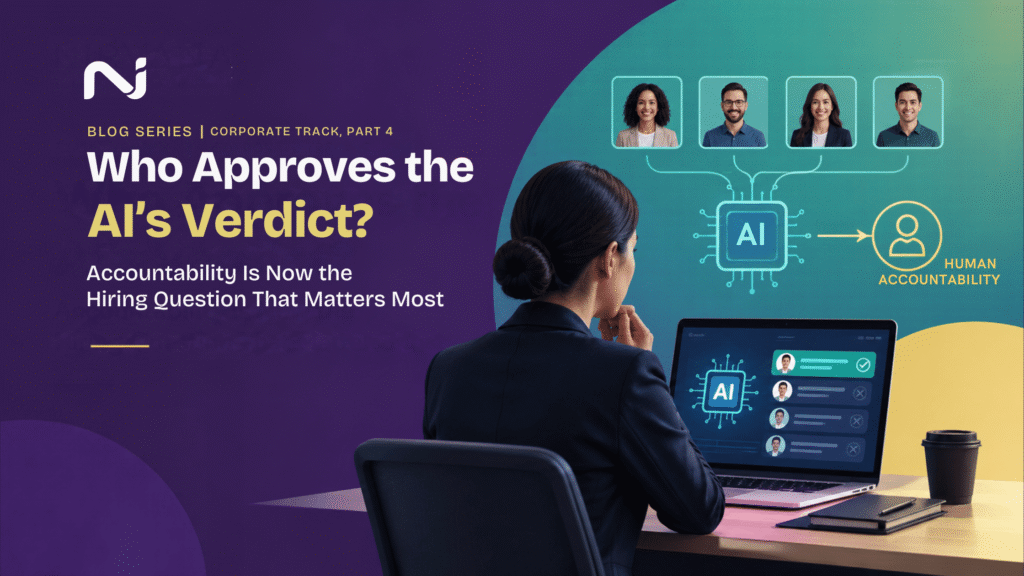
Parts 1 through 3 of this series covered the interview, the résumé, and the single test score — three familiar weak links in hiring. This one is about something newer: a growing number of hiring decisions now have an AI system somewhere in the chain, scoring a candidate, ranking a shortlist, or recommending a reject. The question that actually matters isn't whether AI should be involved. It's who is accountable when it is — and regulators in multiple jurisdictions have started answering that question whether employers have caught up or not.
Nirvana Intellect — Blog Series, Corporate Track, Part 4
Parts 1 through 3 of this series covered the interview, the résumé, and the single test score — three familiar weak links in hiring. This one is about something newer: a growing number of hiring decisions now have an AI system somewhere in the chain, scoring a candidate, ranking a shortlist, or recommending a reject. The question that actually matters isn’t whether AI should be involved. It’s who is accountable when it is — and regulators in multiple jurisdictions have started answering that question whether employers have caught up or not.
The regulatory floor is rising, not staying still
Colorado became the first U.S. state to pass comprehensive AI legislation with direct application to hiring. Senate Bill 24-205 classifies any AI system that makes or is a substantial factor in a “consequential decision” — explicitly including employment — as “high-risk,” regardless of whether a human is nominally involved in the final call (Colorado General Assembly). Covered employers face annual impact assessments, a documented risk-management policy, and — notably — a requirement to let an affected candidate appeal an adverse decision, with that appeal reviewed by a human wherever possible. That last detail is the whole argument of this post in regulatory form: the law doesn’t ban AI from hiring. It requires that a human remain reachable when the AI gets it wrong.
New York City got there first with Local Law 144, which requires an independent bias audit of any automated employment decision tool before it’s used to screen candidates, with the results made public — a requirement covered in more detail in “The Interview Illusion” earlier in this track. The pattern across jurisdictions is consistent even where the specific rules differ: transparency about what the tool does, and a documented point where human accountability re-enters the process.
“The algorithm recommended them” was never going to be a defense
This isn’t just a new-law problem — it’s an old-law problem that AI made easier to accidentally trigger. The Uniform Guidelines on Employee Selection Procedures require any selection method to be job-related and free of unjustified adverse impact, and that obligation doesn’t pause because the method in question is a model instead of a person (EEOC). A hiring team that can’t explain why an AI tool ranked one candidate above another — because nobody validated the tool, or nobody kept a record of how it was configured — is in exactly the exposure the Guidelines were written to prevent, just with a newer-looking tool producing the same old undocumented outcome.
The Society for Industrial and Organizational Psychology’s own guidance for AI-based assessments is explicit that this doesn’t get easier just because a system is automated: every AI-based assessment used in selection should have content clearly tied to the job, produce fair and consistent scores, demonstrate it predicts actual performance, and have every step of its development and scoring documented for audit (SIOP). “It’s an algorithm” has never been an acceptable substitute for that evidence — it just took regulators a few years to write it into statute.
What accountable AI use in hiring actually looks like
- A named, qualified person accountable for each AI-assisted hiring decision — not a vague reference to “the system” or “the vendor.”
- Independent bias auditing before deployment, repeated on a regular cycle — not a one-time validation study that’s never revisited as the tool or the candidate pool changes.
- A documented rationale for how AI output fed into the final decision — score plus context, not score as verdict.
- A real, working appeal path for a rejected candidate to reach a human reviewer — not a submission form that disappears into a queue nobody actually checks.
This is precisely where a governed AI layer distinguishes itself from an AI shortcut: using AI to draft evaluations, surface skills evidence, and flag inconsistency — the way earlier parts of this track described for interviews and résumé screening — while keeping a permanent, auditable record of what the AI recommended, why, and who signed off on it. See how Nirvana Intellect governs AI-assisted hiring decisions →
Why this is the hinge point of the corporate track
Every problem this track has covered so far — the interview illusion, the unverified résumé, the single score treated as gospel — gets worse, not better, if you bolt an unaccountable AI system on top of it. “Skills, Not Résumés” and “The One-Score Fallacy” both end on the same principle this post makes explicit: AI can strengthen the evidence behind a hiring decision, but only when a specific, identifiable person remains accountable for what that evidence is used to decide.
Explore Nirvana Intellect’s capability intelligence →
That’s Part 4 of this track. Next: what happens once hiring is right and the question shifts to the people already inside the organization — mapping the capability you already have, not just the capability you’re screening for.

