
Assessment guidance
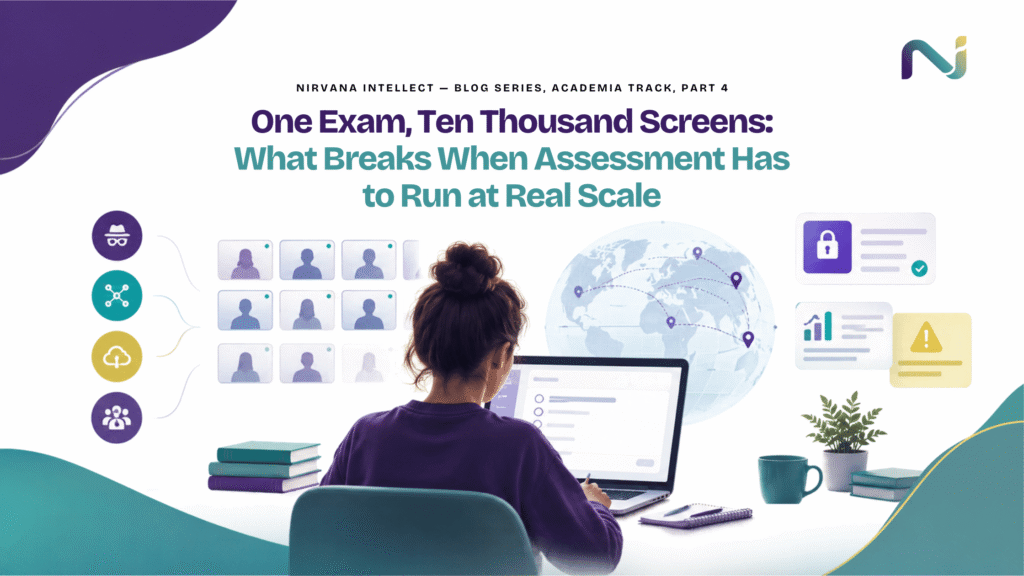
One Exam, Ten Thousand Screens: What Breaks When Assessment Has to Run at Real Scale
Parts 1 through 3 of this series looked at scoring, marker consistency, and the paper trail behind a single result. This one is about what happens to all of that once you multiply it by ten thousand candidates sitting the same exam, at the same time, often from ten thousand different locations. Scale doesn't just make the existing problems bigger - it introduces a new category of failure that a small, in-person sitting never has to face: malpractice at industrial scale, and infrastructure that has to hold under genuine concurrent load.
Nirvana Intellect — Blog Series, Academia Track, Part 4
Parts 1 through 3 of this series looked at scoring, marker consistency, and the paper trail behind a single result. This one is about what happens to all of that once you multiply it by ten thousand candidates sitting the same exam, at the same time, often from ten thousand different locations. Scale doesn’t just make the existing problems bigger — it introduces a new category of failure that a small, in-person sitting never has to face: malpractice at industrial scale, and infrastructure that has to hold under genuine concurrent load.
The malpractice problem changed shape, not size
Moving assessment online was supposed to make cheating harder to organise. In several well-documented cases it’s made it easier to industrialise. A first-of-its-kind technical security analysis of the proctoring software used in U.S. law-licensing and bar examinations reverse-engineered four major platforms and found that, despite vendor claims of high security, their anti-cheating measures could be trivially bypassed — with real security and privacy risk to test-takers as a side effect (arXiv technical analysis). This isn’t a story about a careless vendor. It’s a structural point: monitoring software built to watch one candidate through a webcam is fighting a fundamentally different battle than an exam board’s actual exposure, which is coordinated, organised cheating across a candidate pool that can run into the hundreds of thousands.
India’s regulators reached the same conclusion through a different route: legislation rather than a security audit. The Public Examinations (Prevention of Unfair Means) Act, 2024 — India’s first dedicated national law on the subject — was enacted specifically because paper leaks and organised cheating rings had outgrown what existing law and existing exam-body bylaws could address, defining offences from unauthorised access to the tampering of computer networks and systems used to conduct an exam, with penalties up to ten years’ imprisonment for organised offences (Ministry of Law and Justice, Government of India). When a government concludes that exam integrity at scale needs its own criminal statute, that’s a fairly direct signal that the problem isn’t marginal.
Scale also breaks fairness in ways integrity checks don’t catch
A large-scale remote exam has to work for every candidate sitting it, not just resist the ones trying to cheat. A detailed technical report from UC Berkeley’s EECS department, drawn from running large-scale remote exams across the pandemic years, documented the operational trade-offs directly: proctoring software, bandwidth requirements, and monitoring policies that work fine for a well-resourced candidate on a fast connection can quietly disadvantage a candidate on unreliable internet, older hardware, or in a shared living space — while also finding that well-designed remote exams genuinely improved accessibility and reduced stress for many students when the trade-offs were managed deliberately (UC Berkeley EECS Technical Report). The lesson isn’t that scale makes fairness impossible — it’s that fairness at scale has to be engineered in, not assumed to carry over from how a small in-person sitting used to work.
Where most large-scale sittings actually fail
- Concurrency: infrastructure tested for a few thousand simultaneous candidates buckling when the real number arrives, turning a technical glitch into a fairness incident for everyone affected.
- Uniform proctoring policy applied regardless of candidate circumstances – bandwidth, device, accessibility needs – rather than accommodations built in from the start.
- Malpractice detection tuned to catch an individual candidate’s suspicious behaviour, with no mechanism for spotting coordinated, cross-candidate patterns that only show up in aggregate.
- No pre-agreed incident protocol – so when something does go wrong for a subset of candidates, the response is improvised in real time rather than following a tested plan.
What running assessment at scale actually requires
Not a bigger version of a small exam’s process — a different design discipline entirely:
- Load-tested infrastructure with a documented safety margin above the largest realistic concurrent sitting, not just above the average one.
- Malpractice detection that looks across candidates for coordinated patterns – shared answer sequences, timing correlations – not only within a single candidate’s session.
- Accessibility and connectivity accommodations designed in before the exam window opens, not handled as exceptions once a candidate reports a problem.
- A pre-agreed incident response protocol – what happens to affected candidates’ results if a platform issue hits mid-exam – decided before it’s needed, not improvised while it’s happening.
This is a genuinely strong use case for AI in assessment: monitoring aggregate patterns across a candidate pool that a human invigilation team simply cannot watch for individually, flagging statistical anomalies for human review rather than either ignoring them or auto-flagging individual students without a person checking the case. As covered in “Who Grades the Grader?”, the principle holds here too – AI surfaces what a human process at this scale would miss; a qualified person still decides what it means. See how Nirvana Intellect approaches assessment delivery at scale →
Why this connects back to the rest of the series
A scorecard that isn’t evidence (Part 1), a marking process that isn’t consistent (Part 2), and a result nobody can produce a paper trail for (Part 3) all get dramatically worse once you’re running at scale, because scale removes the slack that let smaller institutions patch over gaps informally. Getting delivery right at scale isn’t a separate problem from the rest of this series – it’s where all of the earlier ones show up at once, for every candidate, simultaneously. Explore Nirvana Intellect’s approach to governed assessment →
That’s Part 4 of this track. Next: what an institution can actually promise a parent – or a court – about how a result was reached.

