
Assessment guidance
The Scorecard Lie: Why a Grade Alone Isn’t Assessment Evidence
A student gets 78%. Another gets 79%. On paper, the second student did marginally better. In reality, neither number tells you what either student actually understands, how the answer was reached, or whether the same question graded by a different examiner would have produced the same mark at all.
Nirvana Intellect — Blog Series, Academia Track, Part 1
A student gets 78%. Another gets 79%. On paper, the second student did marginally better. In reality, neither number tells you what either student actually understands, how the answer was reached, or whether the same question graded by a different examiner would have produced the same mark at all.
This is the quiet contradiction sitting inside almost every grading system in academia: the number looks precise, but the process behind it is often far less rigorous than the number implies. That gap between apparent precision and actual defensibility is what we’re calling the scorecard lie — and it’s the opening problem in a series on what governed, evidence-led assessment actually requires.
A score was never meant to stand alone
Grades exist to compress a large amount of information — how a student reasoned, where they went wrong, what they understood well — into a single comparable figure. Compression is useful. It’s also lossy. The Standards for Educational and Psychological Testing, jointly published by the American Educational Research Association, the American Psychological Association and the National Council on Measurement in Education, exist precisely because a raw score means nothing without validity evidence behind it — proof that the score actually measures what it claims to, and that it was arrived at through a defensible process.
Most institutions still don’t keep that evidence in a form anyone could retrieve later. The rubric exists in a marker’s head, not in a system. The reasoning behind a borderline grade lives in a margin note, if it’s written down at all. When a result is challenged, someone has to reconstruct a decision that was never fully recorded in the first place.
Where the process actually breaks
- Marker inconsistency- Give the same constructed-response answer to two qualified examiners and you will not reliably get the same mark. Recent research applying intraclass correlation to physics exam scoring found human raters agreed well on clearly strong or clearly weak answers (ICC around 0.92), but agreement collapsed for the mid-level responses where most real grading disputes actually live, dropping to roughly 0.28 among human raters alone (arXiv, 2026). That’s not a story about bad examiners — it’s a story about rubrics that are clear at the extremes and ambiguous everywhere else, which is exactly where borderline grade appeals concentrate.
- No audit trail- Testing researchers who study rater behavior have pointed out that standard inter-rater reliability statistics tell you how often two markers agreed, but not why either of them scored the way they did (National Center for the Improvement of Educational Assessment). Agreement isn’t the same as accuracy, and neither is retrievable evidence — which is precisely what’s missing when a registrar has to respond to a formal re-evaluation request months after the exam was sat.
- AI entering the picture without a governance layer- As generative AI becomes part of both how students write and how institutions consider grading, the assessment community’s own guidance converges on one point: AI can assist evaluation, but shouldn’t operate without human oversight and institutional policy around it. UNESCO’s guidance for higher education frames this explicitly as a governance and policy question, not just a detection-tool question (UNESCO IESALC). Bolting an AI grading tool onto an ungoverned process doesn’t fix the scorecard lie — it just makes the number look more authoritative while the underlying evidence problem stays exactly where it was.
What defensible grading actually requires
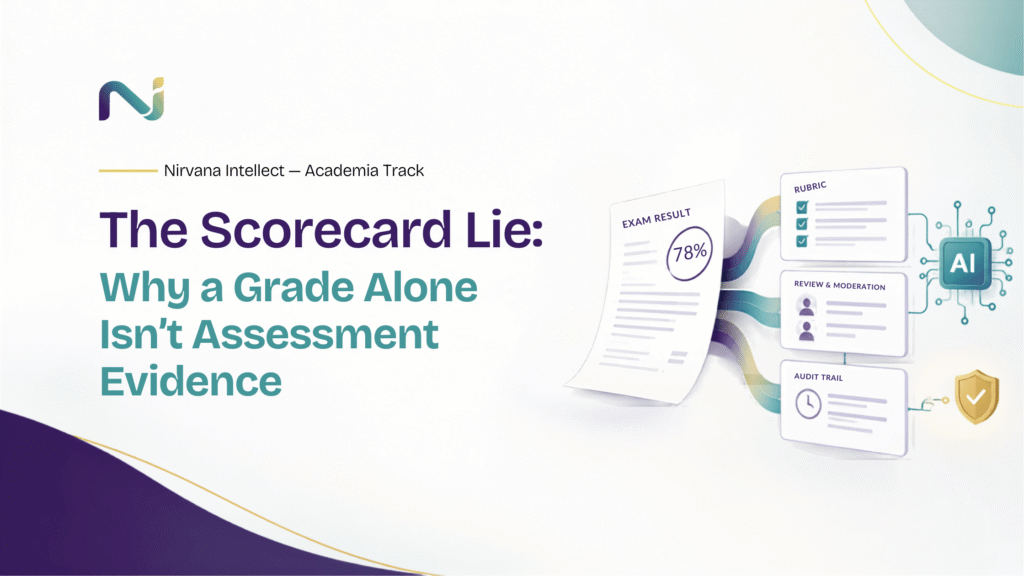
None of this means scores are useless or that human judgment should be removed from evaluation. It means a score needs three things behind it before it can be called evidence rather than an opinion with a number attached:
- A structured rubric applied consistently, with the criteria — not just the final mark — recorded against each response.
- A visible chain of review, so a second marker, a moderator, or an appeals panel can see how a borderline decision was actually reached, not just what it concluded.
- A frozen, retrievable record of the response, the rubric version used, and the reviewer who approved the outcome — available the day the result is challenged, not reconstructed from memory months later.
This is the shift from administering an exam to governing an assessment — treating every result as something that has to hold up to scrutiny, not just get published on time. It’s also precisely where AI is genuinely useful: drafting a first-pass score against a rubric, flagging inconsistent marking patterns across a cohort, surfacing borderline cases for moderation — while a qualified human still approves every outcome that affects a student’s record. See how Nirvana Intellect’s evaluation and capability intelligence works →
Why this matters more than institutions think
Every re-evaluation request, every RTI filing, every parent phone call about a grade is really a request for evidence an institution may not actually have. Getting this right isn’t just a risk-management exercise — it’s what lets a result mean something to the person who earned it, and stand up when someone asks how it was reached. Explore how governed academic assessment is built for exactly this →
That’s the problem this series exists to work through, one piece at a time. Next: what happens when a result is formally challenged, and an institution has to produce the paper trail it never quite built.

