
Assessment guidance
The Interview Illusion: Why “Gut Feel” Hiring Is Costing You the Best Candidate
Most hiring managers can describe, in detail, the moment they knew a candidate was “the one.” A confident answer. A likeable tone. A feeling that clicked around minute four of the conversation. What they usually can't describe is why that feeling turned out to be wrong roughly half the time.
Nirvana Intellect — Blog Series, Corporate Track, Part 1
Most hiring managers can describe, in detail, the moment they knew a candidate was “the one.” A confident answer. A likeable tone. A feeling that clicked around minute four of the conversation. What they usually can’t describe is why that feeling turned out to be wrong roughly half the time.
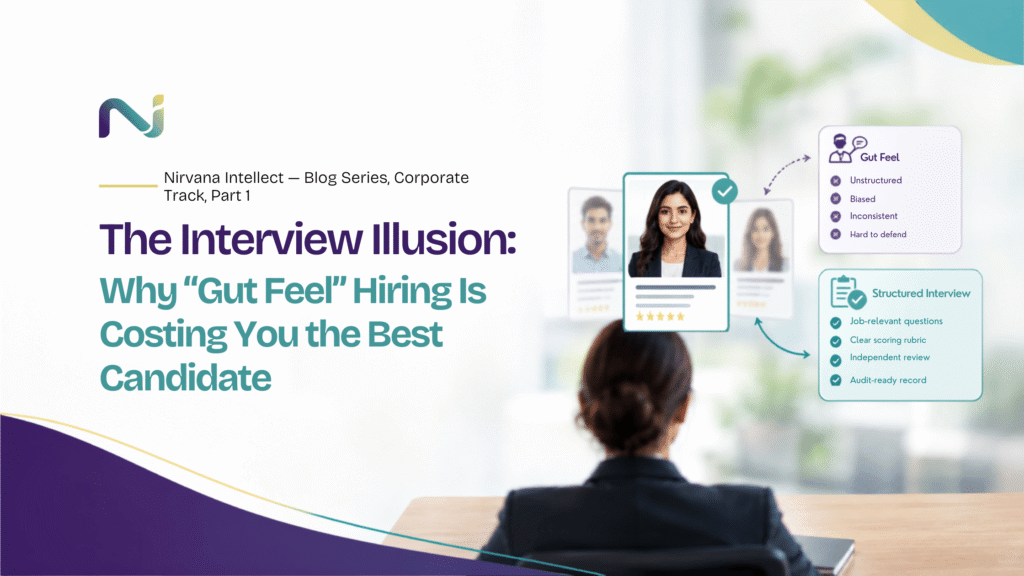
Unstructured interviews — the free-flowing conversation most companies still run — are one of the weakest predictors of job performance that industrial-organizational psychology has ever measured, and decades of research keep confirming it. That’s the interview illusion: it feels like careful evaluation, but it’s mostly a very confident guess.
What the research actually shows
The reference study here is Schmidt and Hunter’s landmark meta-analysis covering 85 years of selection-method validation research, which found structured interviews predict job performance at roughly r = 0.51, against about 0.38 for unstructured interviews. A 2022 re-analysis by Sackett, Zhang, Berry and Lievens revisited those numbers with corrected statistical methods and still ranked structured interviews near the top of all selection methods — with unstructured interviews trailing well behind, closer to the range of a weak signal than a reliable one.
The U.S. federal government’s own hiring guidance backs the same conclusion: a documented body of research shows that job-related, competency-based structured interview questions produce measurably higher validity, reliability, and rater agreement than free-form conversation (U.S. Office of Personnel Management). The mechanism isn’t mysterious: a structured interview asks every candidate the same job-relevant questions, in the same order, scored against the same rubric. An unstructured one lets each conversation drift toward whatever the interviewer happens to connect with — which is a fine way to enjoy a conversation and a poor way to predict who will actually perform.
Why this isn’t just a quality problem — it’s a legal exposure problem
An interview process that varies candidate to candidate isn’t only less predictive. It’s also harder to defend if a hiring decision is ever challenged. The Uniform Guidelines on Employee Selection Procedures, adopted jointly by the EEOC, the Department of Labor and the Department of Justice, require employers to be able to show that a selection procedure is job-related and doesn’t produce an adverse impact on any protected group. That requirement doesn’t disappear because a decision came from a “conversation” rather than a formal test — it applies to any procedure used to decide who gets hired.
This is exactly where AI-assisted hiring tools have started raising a second, related question: who’s accountable when the tool — not a person — effectively made the call? New York City’s Local Law 144 became one of the first concrete answers, requiring an independent bias audit of any automated employment decision tool before it’s used to screen candidates, along with public disclosure of the results (overview of NYC Local Law 144). The regulatory direction is consistent across jurisdictions: AI can inform a hiring decision, but the accountability for that decision still has to sit with a person who can explain and defend it.
What a defensible hiring process actually needs
Fixing this isn’t about banning interviews or removing human judgment — it’s about giving that judgment a structure it can be held to:
- A fixed set of job-relevant questions, built from an actual job analysis, asked in the same order to every candidate for the role.
- A scoring rubric with defined anchors, so “strong answer” means the same thing across every interviewer, not whatever each of them personally found persuasive.
- Independent scoring before discussion, so panel conversation doesn’t quietly collapse everyone’s rating toward the most senior or most confident voice in the room.
- A retrievable decision record — the questions asked, the scores given, who approved the final call — available if a rejected candidate or a regulator ever asks how the decision was made.
This is also where AI adds real value without becoming the problem: drafting a first-pass evaluation against a rubric, flagging scoring drift across interviewers, surfacing skills evidence from structured work samples — while a qualified person still approves every decision that affects a candidate’s outcome. See how Nirvana Intellect governs hiring and workforce capability evaluation →
The real cost of getting this wrong
A mis-hire isn’t a rounding error — replacing a poor hire can run to a substantial multiple of that role’s annual cost once recruiting, onboarding and lost productivity are counted. Gut-feel hiring doesn’t just occasionally produce a bad outcome; it produces outcomes nobody can fully explain afterward, good or bad. Explore Nirvana Intellect’s capability intelligence for hiring and workforce decisions →
That’s the opening problem in this series. Next: what happens when the résumé itself — not just the interview — is the thing quietly lying about what a candidate can do.

